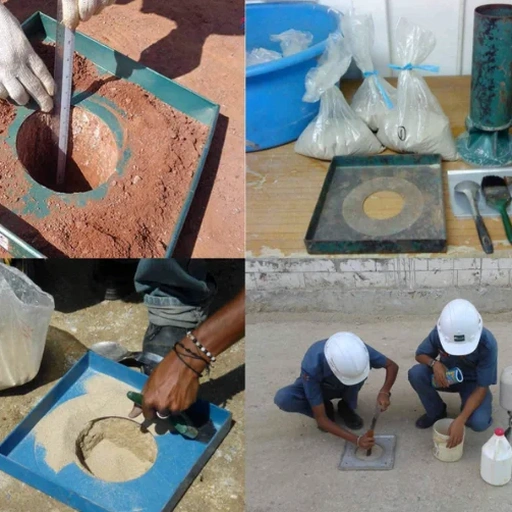
In Bakersfield, the difference between a stable subgrade and a settlement headache often comes down to one number: the in-place density. We have pulled sand cone tests on everything from sandy loam in the Rosedale area to silty clay near the Kern River, and the pattern is always the same — the lab proctor is only half the story. The real proof is what happens under the compactor. Our field team runs the ASTM D1556 sand cone method as a direct check on lift thickness and moisture conditioning, especially during the hot, dry summers when surface evaporation can fool a nuclear gauge. For larger commercial pads, we often pair this with a proctor test to lock in the reference curve before field verification begins.
A proctor curve in the lab means nothing until you verify it with a sand cone in the actual lift.
Methodology and scope
Local considerations
Downtown Bakersfield redevelopment projects and the newer subdivisions west of Highway 99 present two completely different compaction challenges. In the older urban core, we frequently encounter undocumented fill — a mix of construction debris, old brick fragments, and silty sand that was never engineered. Running a sand cone test on that material can give a false pass if you do not recognize the oversized particles skewing the volume measurement. Out west, where many sites sit on Pleistocene alluvial fans, the native soil is often a clean sand with very little cohesion. The risk there is not contamination but moisture sensitivity: a lift compacted at 2 percent below optimum can test above 95 percent relative compaction on the sand cone, only to collapse later when irrigation water or winter rain saturates the subgrade. We have seen this exact failure mode on three separate commercial pads in the last five years, and in every case the field density number alone, without a moisture check, looked fine on paper.
Applicable standards
ASTM D1556-15e1 — Standard Test Method for Density and Unit Weight of Soil in Place by the Sand-Cone Method, ASTM D698-12e2 — Standard Test Methods for Laboratory Compaction Characteristics of Soil Using Standard Effort, ASTM D2216-19 — Standard Test Methods for Laboratory Determination of Water (Moisture) Content of Soil and Rock by Mass, Caltrans CTM 231 — Relative Compaction for Unbound Soils (when applicable on Caltrans-funded work), IBC 2018 Section 1803.5.6 — Compaction testing for foundation subgrade
Associated technical services
In-Place Field Density by Sand Cone (ASTM D1556)
Direct volumetric measurement of compacted soil density using calibrated Ottawa sand. We test subgrade, structural fill, utility trench backfill, and aggregate base. Each test includes moisture content determination and a comparison to the laboratory maximum dry density curve. Our technicians carry current radiation safety training even though the sand cone is non-nuclear, because many Bakersfield jobsites run both methods side by side.
Proctor Compaction Curves (ASTM D698 / D1557)
Standard and modified proctor testing on native soils and imported fill materials sourced from Kern County borrow pits. We run multi-point curves with full saturation control, and we can turn around a standard proctor within 24 hours for urgent trench backfill inspections. The curve is the baseline against which every field density test is judged.
Typical parameters
Frequently asked questions
How much does a field density test (sand cone method) cost in Bakersfield?
A single sand cone density test on a Bakersfield jobsite typically runs between US$100 and US$160 per point, depending on travel distance and whether moisture content is determined by oven-dry or Speedy moisture tester. Most compaction inspection projects require a minimum of three to five test points per day to be statistically meaningful, so a half-day of testing generally falls in the US$400 to US$700 range. We provide a fixed-rate proposal after reviewing the project specs and site location.
When should I use a sand cone instead of a nuclear density gauge on my Bakersfield project?
The sand cone is the referee method in Bakersfield when nuclear gauge readings are suspicious or when the soil contains materials that throw off the gauge calibration — things like high-iron aggregates from local alluvial deposits or soils with significant gypsum content. It is also required by many Caltrans and city of Bakersfield specs for acceptance testing on critical structural fills. The tradeoff is time: a sand cone test takes about 15 to 20 minutes per point versus a couple of minutes for a nuclear gauge, so we usually recommend it for final verification rather than continuous compaction monitoring.
How deep do you dig the hole for a sand cone test, and does it work in gravelly Bakersfield soils?
The standard test hole is between 4 and 6 inches deep, matching the loose lift thickness of the compacted layer. In Bakersfield soils with gravel larger than 1.5 inches, we use a larger base plate and dig a deeper, wider hole following the ASTM D4914 large sand cone procedure, or we switch to a water replacement method (ASTM D5030). The key is that the volume of the test hole must be at least 20 times the volume of the largest particle, otherwise one stone can ruin the measurement.