The drill rigs we mobilize for anchor installation in Bakersfield's soil profile are typically rotary-percussive top-hammer units paired with high-torque duplex casing systems. In the alluvial fan deposits that characterize the Kern River basin, maintaining borehole stability during drilling is a non-negotiable step: the granular matrix of sand, silt, and occasional cobbles collapses the moment fluid pressure drops, so the casing has to advance simultaneously with the drill string. Our field crews set up the grout plant and stressing jack on compacted pads, often within tight right-of-way constraints along State Route 99 or Rosedale Highway corridors, where tieback anchors for soldier pile walls must navigate existing utilities and remain within property boundaries. The design itself is developed by our engineering team using load-transfer analysis methods calibrated to SPT-N values from the site investigation, which in this region rarely exceed 30 blows per foot below 15 meters of depth due to the basin's sedimentary history.
In saturated alluvial silts below the groundwater table, post-grouting the bond zone can increase ultimate anchor capacity by 25 to 40 percent over single-stage gravity grouting.
How we work
Local considerations
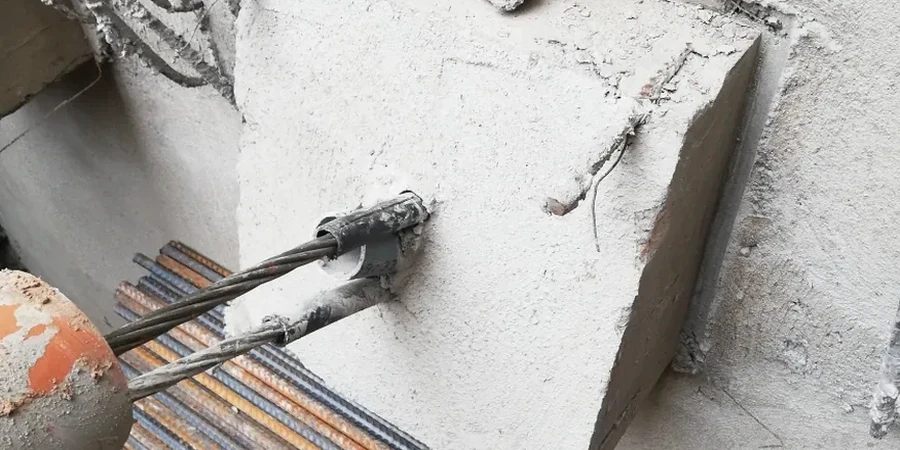
Bakersfield's urban expansion, particularly the post-1970 push into former agricultural parcels east of the 99 freeway and north of the Kern River, created a patchwork of fill soils and abandoned irrigation infrastructure that still haunts excavation projects today. Old concrete-lined ditches, buried well casings, and uncompacted sandy fill show up without warning during anchor drilling, requiring rapid design adjustments when the borehole encounters voids or sudden loss of flush return. The seismic hazard adds another layer of complexity: the city sits within a region of moderate-to-high seismicity influenced by the White Wolf Fault (source of the 1952 magnitude 7.3 Kern County earthquake) and the nearby San Andreas system, which means permanent tieback anchors for retaining structures must account for cyclic load degradation in the grout-soil bond. Our design approach incorporates a 20 percent reduction factor on the ultimate bond stress for permanent anchors in potentially liquefiable sand layers, as recommended by FHWA guidelines for seismic conditions, and we specify full-length corrugated sheathing with factory-applied epoxy coating on the strand bundle to guard against corrosion in the alkaline, agricultural-drainage-affected groundwater that is common throughout the southern San Joaquin Valley.
Video resource
Relevant standards
The design of active and passive anchors for deep excavations in Bakersfield references PTI DC35.1-14 for prestressed rock and soil anchors, FHWA-NHI-10-024 for ground anchors and anchored systems, ASTM A416 for low-relaxation seven-wire steel strand, AASHTO LRFD Section 11 for abutments, piers, and walls, and IBC 2021 Chapter 18 for soils and foundations as adopted by the City of Bakersfield.
Associated technical services
Tieback anchor design for shoring walls
Complete design package including free length and bond length calculation, tendon selection per ASTM A416, corrosion protection specification, and staged stressing sequence for soldier pile and secant pile walls in Bakersfield's alluvial soils.
Load testing and verification
Performance tests, proof tests, and extended creep tests conducted with calibrated hydraulic jacks and digital load cells. We provide lift-off testing on 100% of production anchors and extended monitoring on 10% to confirm residual load retention.
Typical parameters
Common questions
What is the difference between active and passive anchors?
Active anchors are stressed to a predetermined load after grout curing, applying an immediate compressive force to the retained soil mass. Passive anchors are unstressed and only develop resistance as the wall deforms and the anchor elongates. In Bakersfield's alluvial silts, where even small wall movements can propagate to adjacent street pavements or buried utilities, we specify active post-tensioned anchors for almost all urban excavation support because they limit lateral deflection to less than half an inch at the wall crest.
How deep do anchors need to be installed in Bakersfield soils?
The bonded zone of the anchor must extend beyond the theoretical failure surface, which for a vertical cut in Bakersfield's silty sand typically puts the bond length starting 15 to 20 feet behind the wall face and extending another 15 to 30 feet into undisturbed native alluvium. The exact depth and inclination depend on the SPT-N profile from the geotechnical investigation, the proximity of adjacent structures, and the presence of groundwater, which we encounter as shallow as 8 feet in areas near the Kern River.
What corrosion protection is required for permanent anchors?
For permanent anchors with a design life exceeding 24 months, we specify PTI Class I protection, which includes full-length corrugated plastic sheathing over epoxy-coated strand, factory-grouted internal interstices, and a minimum 0.5 inches of neat cement grout cover between the sheath and the borehole wall. This is particularly important in Bakersfield where agricultural drainage and fertilizer residues in the shallow groundwater can accelerate corrosion of unprotected steel.
How much does anchor design and testing cost for a typical project?
What site investigation data is needed before anchor design can begin?
We require SPT-N values at minimum 5-foot intervals through the full depth of the proposed bond zone, laboratory grain-size distribution curves to classify the soils, Atterberg limits on any cohesive layers, and groundwater level measurements from at least two seasonal readings. For projects near the White Wolf Fault or in areas with known liquefaction potential, we also request seismic velocity data or a site-specific liquefaction analysis to inform the cyclic load reduction factors applied to the bond stress calculations. More info.