The San Joaquin Valley floor beneath Bakersfield consists largely of Holocene alluvium — interbedded clays, silts, and loose sands — with groundwater often within 10 to 15 feet of the surface. When a site investigation returns SPT N-values below 8 in the upper 20 feet, conventional shallow footings become uneconomical and risky. Stone column design offers a vibro-replacement solution that densifies the matrix, creates drainage paths, and transfers load to deeper, more competent strata. Our team combines site-specific settlement tolerances with triaxial testing on composite samples to calibrate the modulus of the stone-soil unit, and we cross-check liquefaction susceptibility using liquefaction analysis where the groundwater table intersects loose sandy lenses — a scenario we have documented repeatedly in projects near the Kern River and its paleochannels.
Stone columns in Bakersfield's alluvial basin do more than support load — they accelerate consolidation drainage, cutting post-construction settlement time by 40 to 60 percent.
How we work
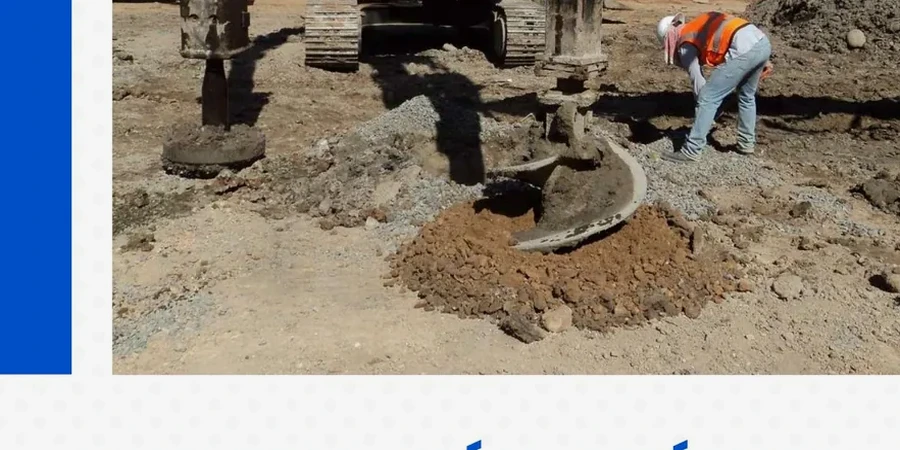
Local considerations
Bakersfield's expansion east and northwest over the last three decades has pushed development onto former agricultural land underlain by thick sequences of compressible clay and organic silts. The 1952 Kern County earthquake, a magnitude 7.3 event on the White Wolf Fault, demonstrated how saturated alluvium can amplify ground motion and trigger differential settlement. A stone column field designed without a site-specific seismic settlement analysis — relying instead on generic reduction factors — risks leaving the improved ground vulnerable to excess pore pressure buildup during a design-level event. We integrate nonlinear effective-stress analysis using SPT- and CPT-based liquefaction triggering correlations, and we incorporate the post-earthquake reconsolidation settlement into the total and differential settlement budget. For structures classified as Risk Category III or IV under ASCE 7-22, this step is not optional — it is the difference between a foundation that survives and one that requires costly post-event releveling.
Relevant standards
Applicable standards include FHWA-NHI-16-027 for ground improvement methods, ASCE 7-22 for minimum design loads, and IBC 2024 Chapter 18 for soils.
Associated technical services
Geotechnical investigation and parameter selection
Execution and interpretation of SPT borings and CPT soundings to define the undrained shear strength profile, groundwater regime, and depth to bearing stratum, forming the geotechnical basis for column design.
Stone column design and settlement analysis
Development of column layout — diameter, spacing, depth, and triangular or square grid — using the Priebe method and 2D/3D finite-element models. Deliverables include settlement estimates, bearing capacity verification, and liquefaction mitigation analysis where required.
Construction oversight and verification testing
Field supervision during vibro-replacement installation, post-installation CPT profiling through column centers and inter-column zones, and zone load testing to confirm design modulus and settlement performance.
Typical parameters
Common questions
What soil conditions in Bakersfield make stone columns a suitable choice?
Stone columns work well in the soft to medium-stiff clays and loose silty sands common in the Kern County alluvial basin. When undrained shear strength is below 50 kPa and the groundwater table is shallow — conditions found across much of the valley floor — vibro-replacement densifies the soil and provides controlled drainage, reducing both total and differential settlement.
How do you verify that the installed columns meet the design specifications?
We run CPT soundings directly through the center of selected columns and at the midpoint between columns to compare the post-improvement tip resistance and sleeve friction against the design target. For critical structures, we also perform zone load tests per ASTM D1143, applying up to 150% of the design load to confirm the load-settlement response matches the finite-element predictions.
What is the typical cost range for a stone column design package in Bakersfield?
How long does the design process take from investigation to final submittal?
Field investigation and laboratory testing usually require 2 to 3 weeks. The design phase — including Priebe calculations, finite-element modeling, and drawing preparation — takes an additional 2 to 4 weeks, depending on the structural loading complexity and coordination with the structural engineer.