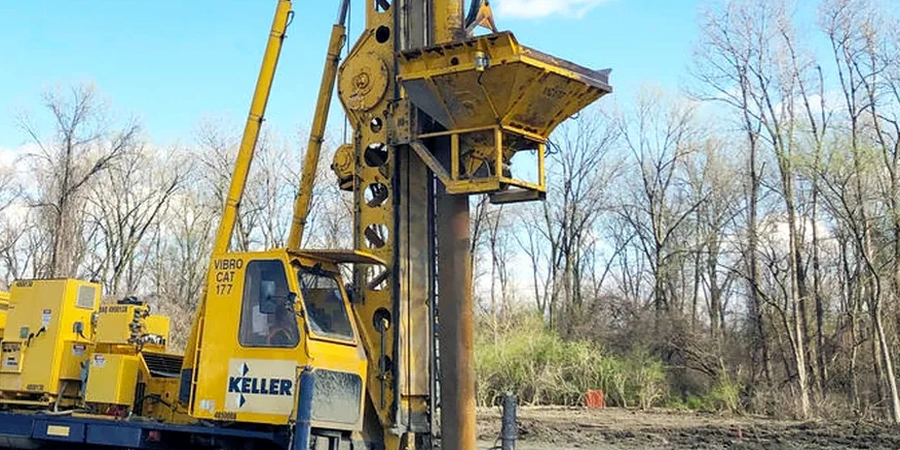
Bakersfield sits on deep Quaternary alluvium shed from the Sierra Nevada and Tehachapi ranges, with loose sand layers extending past 50 feet across much of the valley floor. Groundwater here often rests within 15 feet of the surface, which complicates any shallow foundation but makes vibrocompaction especially effective. In our experience, projects east of Highway 99 encounter the clean, poorly graded sands that respond best to deep vibratory densification. Every design we produce starts with a careful review of SPT drilling logs and CPT soundings because blow count profiles dictate whether the soil will densify or simply rearrange. When the fines content creeps above 15 percent, we typically shift the conversation toward stone columns as an alternative ground improvement method.
In Bakersfield’s loose alluvial sands, a 10 percent gain in relative density can cut post-construction settlement by half—if the grid is tuned to the right energy level.
How we work
Local considerations
ASCE 7-22 Section 11.4.2 places Bakersfield in a region where Site Class D and E profiles are common, and the 5-second spectral acceleration can amplify significantly on loose sand. A vibrocompaction program that raises relative density from 40 to 75 percent shifts the site class upward, often from D to C, which directly reduces the seismic base shear a structural engineer must design for. The local risk that keeps owners up at night is differential settlement beneath large floor slabs: we have seen untreated warehouse pads in the southern industrial parks settle 3 to 4 inches within two years of construction. A properly executed densification design—backed by compaction trials and CPT verification—brings that number below half an inch and distributes it uniformly across the slab footprint.
Relevant standards
ASTM D1586-18 (Standard Test Method for Standard Penetration Test), ASTM D5778-20 (Standard Test Method for Electronic Friction Cone and Piezocone Penetration Testing of Soils), IBC 2021 Section 1806 (Presumptive Load-Bearing Values and Site Class Determination), and ASCE 7-22 Chapter 20 (Site Classification Procedure for Seismic Design) shall be applied.
Associated technical services
Vibrocompaction Trial Program and Grid Optimization
We lay out a compaction trial on the project site using three probe spacings and monitor energy consumption, penetration rate, and CPT improvement for each. The result is a production grid that hits the density target with the fewest probe points.
Production QA/QC and Settlement Verification
During production, we run CPT soundings at 5 percent of probe locations and compare cone resistance to the acceptance envelope defined in the design report. Post-treatment settlement is verified against elastic and creep estimates using the Schmertmann method.
Typical parameters
Common questions
What soil conditions in Bakersfield make vibrocompaction a good choice?
The deep alluvial sands east of Highway 99 are typically clean, poorly graded, and loose, with relative densities between 35 and 45 percent. Groundwater is high, which helps the vibrator achieve full saturation and efficient densification. When fines content stays below 15 percent, vibrocompaction can reach 70 to 85 percent relative density without the added cost of stone backfill.
How much does a vibrocompaction design study cost for a Bakersfield site?
Can vibrocompaction improve liquefaction resistance under Bakersfield buildings?
Yes. By raising the relative density of loose sand above 70 percent, vibrocompaction reduces the void ratio enough to suppress excess pore pressure generation during a design-level earthquake. We use the NCEER/Youd-Idriss procedure to calculate the factor of safety against liquefaction before and after treatment, and the improvement is typically enough to meet IBC performance requirements.
How do you verify that the ground actually improved after vibrocompaction?
We run CPT soundings at pre-selected probe locations before treatment and again after the vibrator has passed. The acceptance criterion is a minimum cone tip resistance profile tied to the target relative density. We also compare pre- and post-treatment SPT blow counts if the original investigation used SPT, and we report the improvement ratio for every verification point.