The design process begins with the drilling rig on site, taking continuous SPT samples in the dense alluvial fans and older river terraces that underlie much of Bakersfield. We log the stratigraphy, looking for the characteristic stiff clays and interbedded silty sands of the Kern River Formation, because a retaining wall here doesn't just hold back soil — it has to perform through 110-degree summer heat that can desiccate the backfill and winter rains that saturate the poorly drained layers. When the borings reach depths of 20 to 30 feet, the engineering team correlates the blow counts with the undrained shear strength needed for lateral earth pressure calculations, building a profile that captures both the near-surface expansive clays and the deeper, more competent strata. For projects near the Kern River or in the older parts of town where groundwater can be shallow, we also install monitoring wells to track seasonal fluctuations that directly affect the wall's drainage design and long-term stability.
A properly designed retaining wall in Bakersfield must handle not just the static earth pressure, but the combined effects of expansive soils, seismic acceleration, and seasonal groundwater — a three-way interaction that drives the factor of safety.
How we work
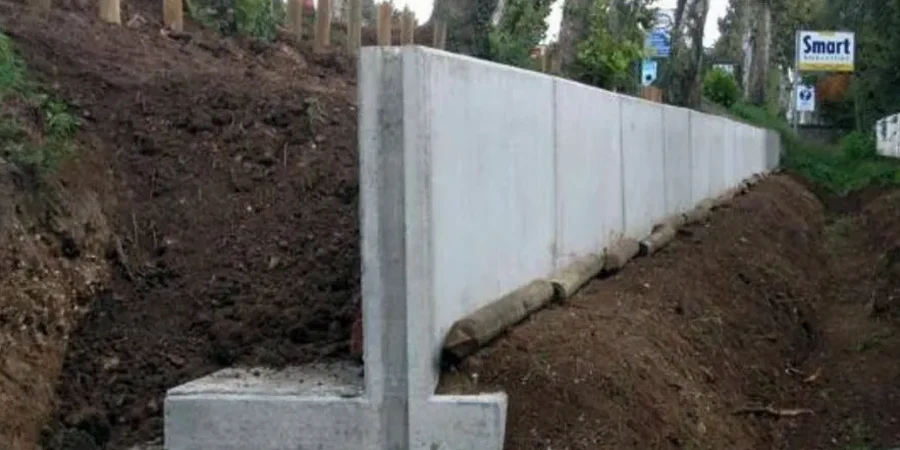
These strength values, combined with the unit weight and at-rest earth pressure coefficient, determine the stem thickness and reinforcement spacing for cantilever walls, or the grid lengths and facing connection strength for mechanically stabilized earth (MSE) systems. In the southeastern parts of the city where the Poso Creek formation brings highly plastic, overconsolidated clays to the surface, we pay particular attention to the swell pressure testing, because a conventional free-draining backfill specification isn't enough — the wall design must include a chimney drain and a filter fabric wrap to prevent the expansive native soil from clogging the drainage system over time. For deeper excavations where the retained height exceeds 15 feet, the slope stability analysis becomes an integral part of the design, checking the global stability of the soil-wall system under both static and seismic conditions.
Local considerations
The most frequent mistake we see from local contractors is treating the retaining wall as a standalone element, digging the footing to the plan depth and pouring concrete without verifying that the bearing stratum actually has the assumed strength. In Bakersfield, the alluvial deposits can change laterally within 20 feet — a trench that starts in a stiff, sandy lean clay can quickly transition into a loose silty lens that was an old channel deposit, and that lens will settle differentially under the wall's eccentric load. We've been called out to walls that tilted outward within the first rainy season because the footing was placed on a zone with an undrained shear strength below 1,000 psf, when the design assumed 2,000 psf. Another failure pattern occurs when the contractor backfills with on-site expansive clay instead of the specified crushed aggregate, and the swelling pressure builds up behind the stem, generating a lateral load two to three times higher than the design value. The result is cracking at the cold joint between the stem and the footing, and once water penetrates that crack, the steel corrodes and the wall's service life drops from 50 years to perhaps 15. A thorough geotechnical investigation — with the borings advanced at least 1.5 times the wall height below the footing — eliminates these surprises.
Relevant standards
The AASHTO LRFD Bridge Design Specifications (9th Ed., 2020), Section 11: Abutments, Piers, and Walls; ASCE 7-22 Minimum Design Loads for Buildings, Chapter 3: Earth Pressure and Chapter 11: Seismic Design; IBC 2021 Section 1807.2: Retaining Walls; ASTM D4767-11(2020): Consolidated-Undrained Triaxial Compression Test; and ASTM D2487-17: Classification of Soils for Engineering Purposes govern the design.
Associated technical services
Cantilever and Gravity Wall Design
Complete geotechnical design package including bearing capacity, sliding, overturning, and global stability checks. We provide stem and footing reinforcement schedules for reinforced concrete cantilever walls, and dimensioned cross-sections for mass gravity walls using local aggregate or segmental block systems. All designs include a site-specific drainage specification with filter gradation curves to prevent piping of fines from the retained soil.
MSE Wall and Soldier Pile Wall Design
For projects requiring retained heights above 15 feet or where space constraints limit the footing width, we design mechanically stabilized earth walls with geogrid reinforcement, and soldier pile and lagging systems for temporary or permanent excavations. The design includes pullout resistance calculations for the reinforcement length, facing connection strength verification, and corrosion protection specifications for steel elements in the moderately aggressive soils common in the southern San Joaquin Valley.
Typical parameters
Common questions
What type of retaining wall is best for the expansive soils in Bakersfield?
For expansive soils like those found in the Poso Creek formation and other clay-rich deposits in Bakersfield, a cantilever reinforced concrete wall with a free-draining backfill zone is generally the most reliable solution. The design must include a chimney drain — a vertical layer of clean, crushed aggregate placed directly behind the wall stem, wrapped in a non-woven geotextile filter fabric — to intercept water and prevent the expansive native soil from exerting swell pressure against the wall. We typically specify a backfill meeting Caltrans Class 2 permeable material gradation, with less than 5 percent passing the No. 200 sieve, compacted to 95 percent of ASTM D698 maximum dry density in 8-inch lifts. Mechanically stabilized earth (MSE) walls can also work well in expansive soils, but the reinforced zone must be entirely within the imported granular fill, and the foundation must be keyed into a non-expansive stratum below the active zone of seasonal moisture fluctuation, which in Bakersfield extends to about 4 to 5 feet below grade.
How much does retaining wall design cost for a project in Bakersfield?
Do I need a geotechnical investigation before designing a retaining wall?
Yes, and skipping this step is precisely how most retaining wall failures in Bakersfield begin. A geotechnical investigation provides the site-specific soil parameters — unit weight, friction angle, cohesion, and the depth to groundwater — that the wall design depends on. Without borings, an engineer must use assumed values that may be unconservative, especially in the alluvial soils of the San Joaquin Valley where stratigraphy changes rapidly. The investigation should include at least one boring advanced to a depth of 1.5 to 2 times the retained wall height below the footing elevation, with Standard Penetration Testing at 5-foot intervals and the collection of undisturbed samples for laboratory strength testing. For walls over 10 feet, or where the wall supports a structure, the investigation must also evaluate the potential for global instability, which requires knowing the strength of soils well below and behind the wall.
How do you account for earthquake loads in retaining wall design?
We apply the Mononobe-Okabe (M-O) pseudo-static method as codified in ASCE 7-22 Section 11.8.3, which treats the seismic increment as an additional lateral earth pressure applied at 0.6H above the base of the wall. For Bakersfield, the horizontal acceleration coefficient (kh) is derived from the site-specific mapped spectral acceleration at short periods, typically reduced by a factor of 1.5 to account for the transient nature of the load and the wall's permissible displacement. The vertical acceleration coefficient (kv) is usually taken as zero unless the site is within 2 kilometers of an active fault trace. The M-O analysis increases the total lateral thrust and rotates the resultant, which has the effect of increasing the required base width and reinforcement. For critical walls — those supporting bridge abutments or structures — we also perform a Newmark sliding block analysis to estimate permanent seismic displacement and ensure it remains within the wall's serviceability tolerance.
What permits are required for a retaining wall in Bakersfield?
Within Bakersfield city limits, retaining walls over 4 feet in height measured from the bottom of the footing to the top of the wall generally require a building permit from the City of Bakersfield Building Department, accompanied by stamped structural calculations and a soils report prepared by a California-licensed civil or geotechnical engineer. Walls that support a surcharge — such as a driveway, a pool, or a neighboring structure — may trigger additional review, and walls over 6 feet often require a grading permit through the Kern County Public Works Department if the project is in unincorporated county territory. The submittal package should include the wall's design parameters, the global stability analysis results with a minimum factor of safety of 1.5 for static conditions and 1.1 for seismic, and the drainage system details. Our design package is prepared specifically to meet the City of Bakersfield's plan check requirements, and we coordinate with the reviewing engineer on any comments or revisions. More info.