Bakersfield sits at the southern end of the San Joaquin Valley, where summer pavement surface temperatures can exceed 140 degrees Fahrenheit and winter nights dip near freezing—a thermal swing that tears ordinary concrete apart. Rigid pavement design here must account for curling stresses, joint expansion capacity, and the region’s notorious expansive clay subgrades that swell with winter irrigation runoff and shrink during months of zero rainfall. The Kern River alluvial deposits underlying much of town produce erratic bearing conditions; a uniform Portland cement concrete slab without proper subbase and load-transfer detailing will pump fines, crack at panel corners, and fail long before its design life. We integrate CBR testing early in the geotechnical phase so the subgrade modulus and k-value fed into the AASHTO 93 equation reflect actual site conditions, not county averages that miss the lenses of loose silty sand common east of Highway 99.
A Bakersfield rigid pavement designed without accounting for the 90-degree daily thermal gradient will curl at the joints and lose subgrade support within three summer cycles.
How we work
Local considerations
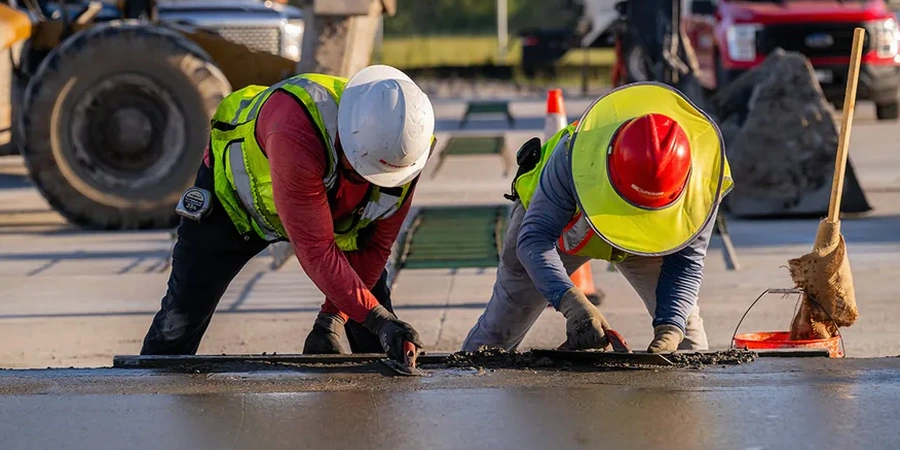
The Caltrans District 6 mobile pavement profiler we deploy on Bakersfield projects mounts a 25-foot-long aluminum truss with five laser sensors sampling the concrete surface at 1-inch intervals. Running it across a freshly placed slab at 5 mph reveals curling magnitudes that are invisible to the eye but fatal to long-term performance. The biggest structural risk in this city is not traffic loading but moisture warping: the dry side of the slab loses water to the 10-percent relative humidity air while the bottom stays near saturation from subgrade vapor migration, creating a permanent upward curl that concentrates wheel loads on the slab edges. A secondary failure mode appears at construction joints in industrial aprons where the alkali-silica reactivity of certain San Joaquin River aggregates, combined with the high alkali cement common in fast-track placements, produces map cracking within five years unless a Class F fly ash or lithium nitrate admixture is specified.
Relevant standards
AASHTO Guide for Design of Pavement Structures (1993, with 1998 supplement), AASHTO MEPDG (Mechanistic-Empirical Pavement Design Guide, NCHRP 1-37A), ASTM C1435 / C1435M (concrete pavement texturing), ASTM D1196 / D1195 (plate bearing test for k-value), Caltrans Highway Design Manual, Chapter 600 (Pavement Engineering), and ACPA design standards for jointed plain concrete pavement (JPCP) are the primary technical references employed.
Associated technical services
PCC thickness design and joint layout
Full AASHTO 1993 and MEPDG analysis calibrated to Bakersfield subgrade k-values and traffic spectra. Includes transverse and longitudinal joint schedules, dowel bar sizing, and tie bar specification for multi-lane industrial and commercial pavements.
Subgrade and subbase evaluation for rigid pavements
In-situ plate bearing tests, CBR determination, and resilient modulus back-calculation to establish the modulus of subgrade reaction (k) used in slab thickness design. Expansive soil mitigation—lime treatment or moisture barrier placement—is specified when plasticity index exceeds 25.
Typical parameters
Common questions
What is the typical rigid pavement design life for a Bakersfield industrial facility?
We design jointed plain concrete pavements for a 30- to 40-year structural life under the AASHTO 1993 framework, assuming a terminal serviceability index of 2.5 and a reliability level of 85 to 95 percent depending on the facility’s operational criticality. The MEPDG approach allows us to model specific distress thresholds—cracking under 5 percent of slabs, faulting under 0.12 inches, and IRI below 170 inches per mile—over the full design period using local climate data from the Meadows Field weather station.
How do expansive soils in Bakersfield affect rigid pavement performance?
The fat clays common west of Highway 99 can generate swell pressures exceeding 5,000 psf during winter moisture uptake, which lifts slab edges unevenly and destroys load transfer at the joints. We address this by specifying a minimum 6-inch cement-treated base that acts as a moisture-stable working platform, adding a geotextile separator to prevent fines migration, and extending the slab edge beyond the building drip line by at least 24 inches so that localized wetting does not create differential heave.
What joint sealant performs best given Bakersfield summer temperatures?
Silicone sealants consistently outperform hot-pour bituminous products in the Central Valley because they maintain elasticity across the full 20-to-140-degree Fahrenheit operating range and resist oxidation under intense UV exposure. We specify low-modulus silicone conforming to ASTM D5893 with a shape factor between 0.5 and 1.0, installed in a reservoir cut that is properly cleaned and backer-rodded to prevent three-sided adhesion.