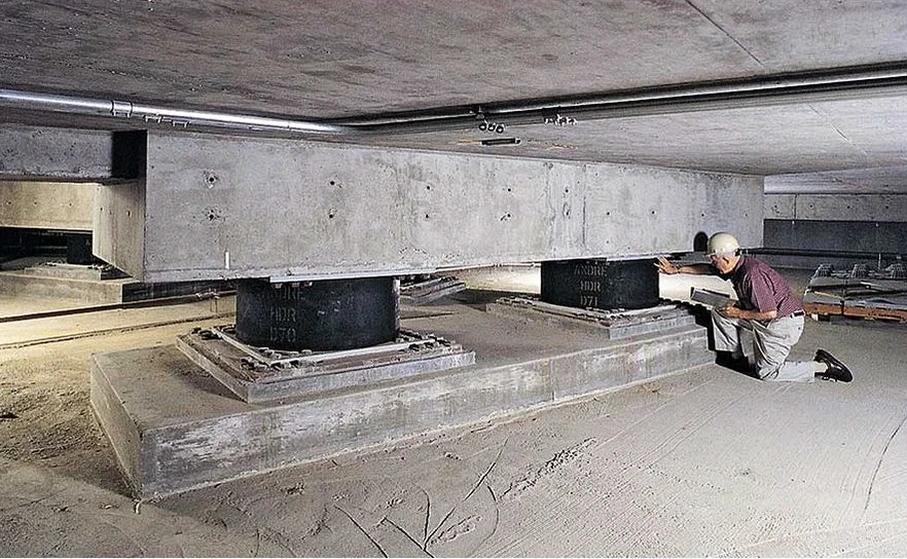
Bakersfield sits 408 feet above sea level, directly atop the deep alluvial sediments of the San Joaquin Basin. The 1952 Kern County earthquake—magnitude 7.3 with an epicenter just 23 miles south—remains the largest seismic event in California since the 1906 San Francisco quake. That event reshaped how we think about ground motion amplification here. Soft sedimentary basins trap and amplify seismic waves, and Bakersfield’s subsurface does exactly that. When a structure demands functional recovery after a design-level event, conventional fixed-base design often falls short. Base isolation seismic design decouples the superstructure from ground motion using elastomeric or sliding bearings. Our laboratory provides the site-specific soil characterization that feeds directly into isolator selection and time-history analysis, following ASCE 7 Chapter 17 requirements. For deep soil sites, we pair isolation studies with MASW testing to establish Vs profiles needed for site-specific response spectra.
Bakersfield’s deep basin sediments amplify long-period motion—exactly where base isolation lives. Getting the soil profile right makes the difference between a functional building and one that needs demolition.
How we work
Local considerations
Downtown Bakersfield and the newer subdivisions in the southwest like Seven Oaks sit on very different soils. The older urban core has compacted, desiccated alluvium with higher stiffness; the southwest expansion areas rest on younger, looser deposits with groundwater at shallower depth. That contrast matters for base isolation design. One site might achieve effective isolation with lead-rubber bearings at an effective period of 3 seconds; the other might require a hybrid system with supplemental damping to control displacements. The risk we see most often in Bakersfield is underestimating near-fault effects. Although the San Andreas Fault lies roughly 40 miles west, the White Wolf Fault that produced the 1952 quake is closer, and the Pond-Poso Creek fault system runs through the eastern edge of the county. Near-source pulse effects can drive isolator displacements beyond code minimums. We run site-specific hazard deaggregation to check whether near-fault directivity should be incorporated into the ground motion selection.
Relevant standards
ASCE 7-22 Chapter 17 (Seismic Isolation), IBC 2024 Section 1705.13, ASTM D2487-17 (Soil Classification), ASTM D4428/D4428M-14 (Crosshole/MASW), and NIST GCR 12-917-21 (Soft-soil basin effects) are applied for base isolation seismic design services in Bakersfield.
Associated technical services
Site-Specific Seismic Hazard & Soil Characterization
Borehole logging, Vs profiling via MASW or downhole, laboratory dynamic testing (resonant column, cyclic triaxial), and development of design spectra per ASCE 7-22. Includes basin amplification analysis for Bakersfield’s deep alluvial setting.
Isolator Foundation Design & Settlement Analysis
Bearing capacity and settlement evaluation for isolator pedestals under combined gravity and seismic overturning. Consolidation testing on Kern County silts and clays to predict long-term settlement that could misalign isolators over the building’s service life.
Typical parameters
Common questions
How much does a base isolation seismic design study cost for a Bakersfield project?
What soil conditions in Bakersfield make base isolation more challenging?
The deep alluvial basin south of the Kern River produces significant long-period amplification. Thick sequences of interbedded silts and clays with variable plasticity create stiffness contrasts that affect wave propagation. Additionally, shallow groundwater in the southwest areas can complicate excavation for isolator pits and requires dewatering during construction of the foundation elements.
Which building types in Bakersfield benefit most from base isolation?
Essential facilities—hospitals, emergency operations centers, and data centers—are the strongest candidates because they need functional recovery after a major earthquake. In Bakersfield’s basin environment, mid-rise structures (4 to 10 stories) with fundamental periods in the 0.5–1.5 second range see the biggest reduction in drift and floor accelerations when isolated, because the soil’s amplification peak overlaps with that period band.