ASTM D1883 sets the bar for subgrade evaluation, and in Bakersfield that bar matters more than most people think. The southern San Joaquin Valley floor is built on thick sequences of alluvial silts and lean clays—materials that lose a lot of strength with moisture. A standard bearing ratio test run on a remolded sample tells you exactly how much. The local irrigation legacy and shallow groundwater south of the Kern River mean many subgrades sit near saturation for weeks at a time. Without a soaked CBR value, pavement thickness design is just guesswork. We run the full procedure: compaction to optimum moisture, four-day soak, and penetration resistance measured with a calibrated load frame at 0.05 inch per minute. The result feeds directly into Caltrans Highway Design Manual curves and AASHTO 93 structural numbers. In practice, we see Bakersfield subgrades range from CBR 2 on fat clays near Lamont to CBR 8 on older terrace gravels east of Highway 99. Those numbers drive everything—aggregate base thickness, lime treatment depth, even the choice between flexible and rigid pavement.
A soaked CBR of 3 on Bakersfield silty clay translates to twice the base thickness of a CBR of 6—knowing that number early saves real money.
Methodology and scope
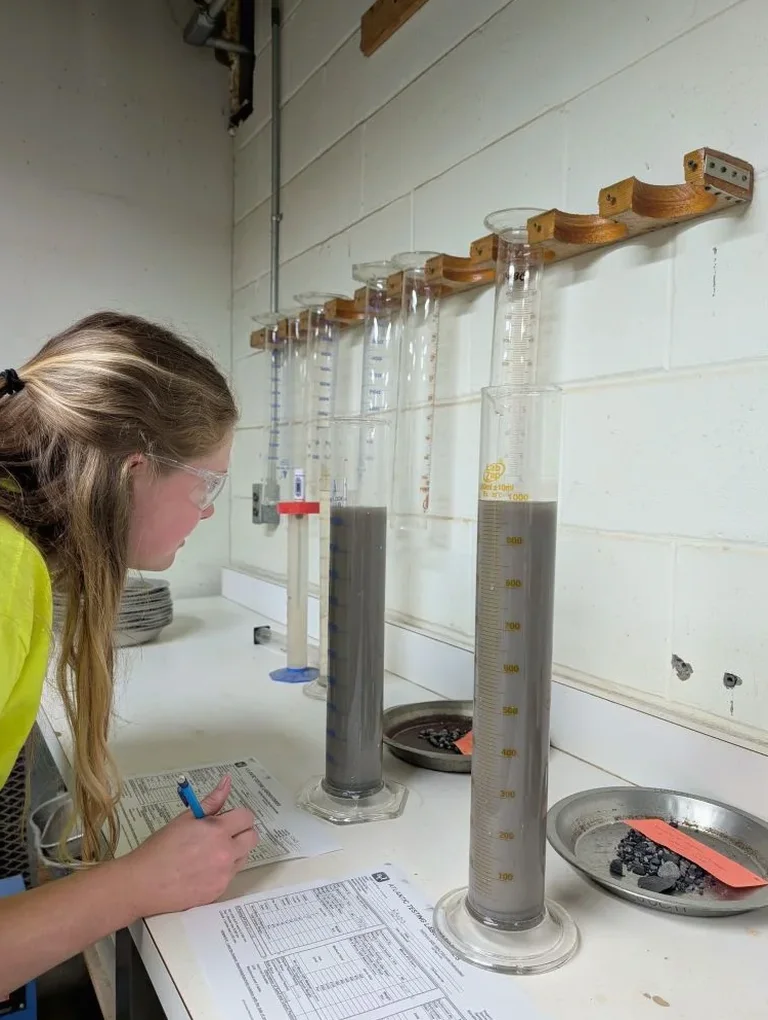
Local considerations
Bakersfield sits in a semi-arid basin where summer temperatures routinely exceed 100°F and winter rains can saturate the upper three feet of subgrade in a single storm. That swing creates a pavement design problem: a material that tests at CBR 12 in August might test at CBR 3 in February. The Kern River’s historical floodplain runs right through the city, leaving behind pockets of high-plasticity clay that shrink and crack during the dry season and turn to slurry when wet. If the CBR test is run only at as-received moisture, the pavement will be underdesigned for the worst-case condition. We’ve seen parking lots in southwest Bakersfield fail within two years because the geotech report used unsoaked values. The fix is simple: always specify the soaked test and compare against both unsoaked and soaked results. For subgrades below CBR 3, stabilization with lime or cement becomes necessary, and the CBR test gets repeated after treatment to verify improvement. Skipping the soaked test is the single costliest shortcut in local pavement engineering.
Applicable standards
ASTM D1883-21, AASHTO T 193-22, Caltrans Highway Design Manual Chapter 600, ASTM D698-12, ASTM D1557-12e1
Associated technical services
Soaked and Unsoaked CBR Package
Full ASTM D1883 program including moisture-density relationship, specimen compaction, 96-hour soak, and penetration testing at two moisture states. Report includes load-penetration curves and corrected CBR values for pavement design input.
Pavement Subgrade Characterization
Combined testing suite that pairs the laboratory CBR with Atterberg limits, grain size distribution, and Proctor compaction. Designed to feed directly into AASHTO 93 structural design or Caltrans mechanistic-empirical pavement analysis.
Typical parameters
Frequently asked questions
What is the difference between soaked and unsoaked CBR and which one should I specify for a project in Bakersfield?
The unsoaked test measures bearing ratio at the compaction moisture content, while the soaked test immerses the specimen in water for 96 hours to simulate long-term wet conditions under the pavement. In Bakersfield, where seasonal irrigation and winter rains raise the groundwater table, we always recommend the soaked CBR. The difference can be dramatic—a silty clay that reads CBR 10 unsoaked might drop to CBR 3 after soaking. Designing with the unsoaked value alone leads to underbuilt pavements that rut and crack within the first few wet seasons.
How much does a laboratory CBR test cost and what does the price include?
A single-point CBR test in our Bakersfield lab runs between US$140 and US$220, depending on whether you need just the soaked value or both soaked and unsoaked conditions. The price covers specimen preparation, compaction to the specified energy level, the four-day soak period with surcharge, and the penetration test with a calibrated load frame. It also includes the load-penetration curve and the corrected CBR values at 0.1 and 0.2 inches of penetration.
How many CBR tests do I need for a typical residential street project in Bakersfield?
For a residential street under 1,000 linear feet, we typically recommend a minimum of three CBR tests taken from different subgrade locations and depths. The alluvial soils in Bakersfield can vary significantly over short distances—a test at one end of the block might return CBR 5 while the other end shows CBR 2 on fat clay. If the borings encounter different soil types, we increase the count accordingly. Three points gives you enough data to calculate a design CBR value per AASHTO or Caltrans statistical procedures without over-testing a small project. More info.